 cargoscribe
 What Is Document Intelligence? A Guide for Logistics and Supply Chain
Document intelligence is AI that understands documents, not just reads them. How it works and where it creates value.
++
What Is Document Intelligence? A Guide for Logistics and Supply Chain
Document intelligence is AI technology that understands and extracts structured information from unstructured documents — PDFs, scanned images, emails, forms, and handwritten records — and makes that information available to downstream systems and workflows. It is the technology that makes it possible to process a stack of shipping documents without a human reading each one.
The term covers a range of technical approaches with very different capabilities. Understanding what document intelligence actually is — and what distinguishes it from simpler approaches like OCR — is the foundation for making good decisions about where and how to deploy it in logistics and supply chain operations.
The Document Problem in Logistics and Supply Chain
Logistics and supply chain operations are among the most document-intensive industries in the economy. A single international shipment generates a bill of lading, a commercial invoice, a packing list, a certificate of origin, customs declarations, an insurance certificate, and potentially a dozen other documents depending on the commodity and destination. Each document contains structured data that must be read, validated, and entered into one or more enterprise systems.
For a mid-size freight forwarder processing 200 shipments per week, that is potentially 2,000 to 4,000 individual documents requiring data extraction and entry. Doing this manually requires a significant operations team, produces a measurable error rate, and creates processing delays that affect the entire supply chain downstream.
Document intelligence addresses this problem by automating the reading, understanding, and extraction of data from these documents — regardless of format, layout, or source.
OCR vs Document Intelligence: The Critical Distinction
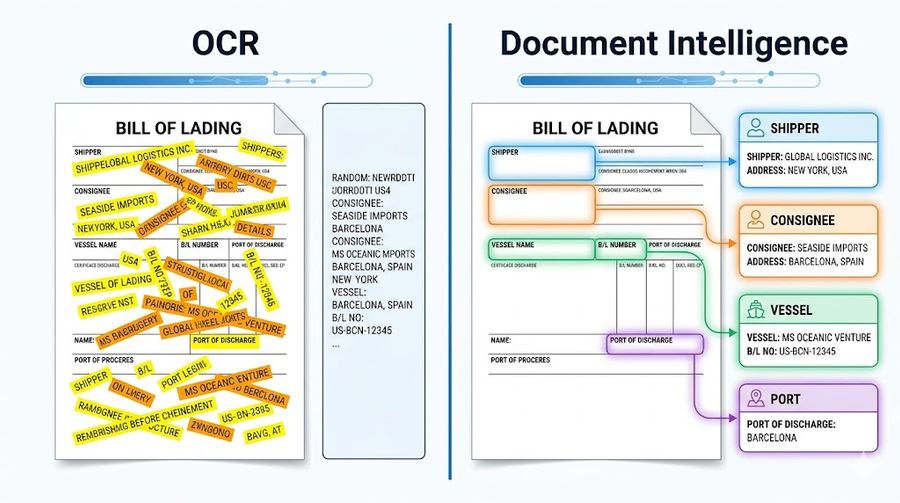
The most important distinction in this space is between Optical Character Recognition (OCR) and document intelligence. The two are frequently confused, and the confusion leads to incorrect technology choices.
OCR converts images of text into machine-readable text.
It recognizes that a pixel pattern represents the letter A, that a sequence of pixel patterns represents the word INVOICE, and outputs that word as a text string. OCR does not understand what INVOICE means, what data it implies should be present nearby, or how to distinguish between the invoice number, the invoice date, and the invoiced amount. It produces a text dump of everything visible on the page.
Document intelligence understands documents.
It knows that a bill of lading has a shipper, a consignee, a notify party, a vessel name, a port of loading, a port of discharge, and a list of cargo items with weights and measurements. It knows that these fields appear in different locations on different bills of lading from different carriers, but that they are always present and always follow predictable patterns. It extracts each field into a structured data record — not a text dump, but a properly labeled dataset ready for system ingestion.
The practical consequence: an OCR-based system requires a template for each document type and each document layout. A logistics company dealing with documents from 50 different carriers needs 50 different templates. When a carrier changes their bill of lading format, the template breaks. Document intelligence systems work without templates because they understand document types rather than document layouts.
How Document Intelligence Works
Modern document intelligence systems operate through a pipeline of several components.
Document classification:
The system first identifies what type of document it is looking at — invoice, purchase order, bill of lading, customs declaration, packing list, or other. This classification determines which extraction model is applied and which fields are expected.
Layout analysis:
The system analyzes the spatial structure of the document — identifying tables, headers, footers, line items, and narrative sections. This structural understanding allows it to correctly associate labels with their values even when the layout differs from previously seen documents.
Entity extraction:
The system extracts the specific data entities required for downstream processing — company names, addresses, dates, item codes, quantities, monetary amounts, reference numbers. Each extracted entity is tagged with a confidence score and, where ambiguous, flagged for human review.
Validation and cross-referencing:
Extracted data is validated against master data — customer records, product catalogs, carrier databases, regulatory requirements. Discrepancies between what is in the document and what is expected based on the shipment record are flagged. For example, if the bill of lading shows a weight that differs significantly from the booking confirmation, the system flags the discrepancy rather than silently passing incorrect data downstream.
Structured output:
The result is a structured data record in the format required by the downstream system — a TMS entry, an ERP transaction, a customs filing, or a reporting database. The record includes provenance information linking each data point back to the source document for audit purposes.
Document Types in Logistics and Supply Chain
Document intelligence deployments in logistics and supply chain typically address some combination of the following document categories.
Commercial documents:
Purchase orders, sales orders, order confirmations, quotes, contracts. These documents initiate the commercial transaction and contain the authoritative data that all downstream documents must reconcile against.
Shipping documents:
Bills of lading, airway bills, sea waybills, truck consignment notes, delivery receipts. These documents track the physical movement of goods and must be matched against the commercial documents they accompany.
Customs and compliance documents:
Customs declarations, certificates of origin, phytosanitary certificates, import permits, dangerous goods declarations. These documents must contain specific data elements in specific formats and are subject to regulatory validation rules.
Financial documents:
Invoices, credit notes, debit notes, payment confirmations. These documents must reconcile against purchase orders and delivery documents to support three-way matching and accounts payable automation.
Where Document Intelligence Creates Value
The primary value of document intelligence in logistics and supply chain comes from three sources.
Processing speed:
Manual document processing in freight operations typically takes 5 to 15 minutes per document for a trained operator. Automated processing takes 15 to 60 seconds including validation. For a freight forwarder processing 500 documents per day, the difference is 40 to 120 person-hours of processing time daily.
Accuracy:
Manual data entry error rates in document-heavy logistics operations typically run between 2 and 5 percent. These errors propagate through the supply chain — a wrong item code on a purchase order creates a wrong entry in the WMS, which creates a wrong pick instruction, which creates a wrong shipment, which creates a returns process. Document intelligence systems with proper validation achieve error rates below 1 percent.
Visibility:
When documents are processed manually, the data in them is often siloed in the document itself rather than available to downstream systems in real time. Document intelligence makes the data immediately available to any connected system the moment the document is processed — enabling real-time shipment status visibility, early exception detection, and automated downstream workflows.
Implementation Considerations
Deploying document intelligence in a logistics or supply chain environment requires attention to several factors.
Document volume and format diversity:
Higher document volumes justify faster payback periods. Format diversity — the number of distinct document layouts in scope — determines the calibration effort required. Operations with highly standardized document sets can go live faster than those with many suppliers, each using different formats.
Integration with existing systems:
The value of document intelligence depends on the extracted data reaching the systems that need it. Integration with TMS, ERP, WMS, and customs management systems through APIs determines how much of the value is captured versus how much is lost to manual re-entry of extracted data.
Exception handling design:
No document intelligence system achieves 100 percent straight-through processing on day one. The design of the exception handling workflow — how exceptions are surfaced, what context is provided to the reviewer, how resolutions are fed back to improve the model — determines the operational impact of the remaining manual work and the rate at which the system improves over time.
CargoScribe: Document Intelligence for Freight and Supply Chain
CargoScribe is the Mirage Metrics document intelligence platform built specifically for freight and supply chain operations. It handles classification, extraction, validation, and integration across commercial documents, shipping documents, customs forms, and financial documents. It connects to TMS, ERP, and customs management systems through direct API integrations and routes exceptions with full context to operations teams. For freight forwarders, customs brokers, and logistics operators dealing with high document volumes and format variability, CargoScribe eliminates the manual processing work that currently limits throughput and accuracy.
MANUFACTURING
READY TO AUTOMATE?
Automate your order intake end-to-end
From email to ERP in seconds — no manual entry, no errors.

++
+

